


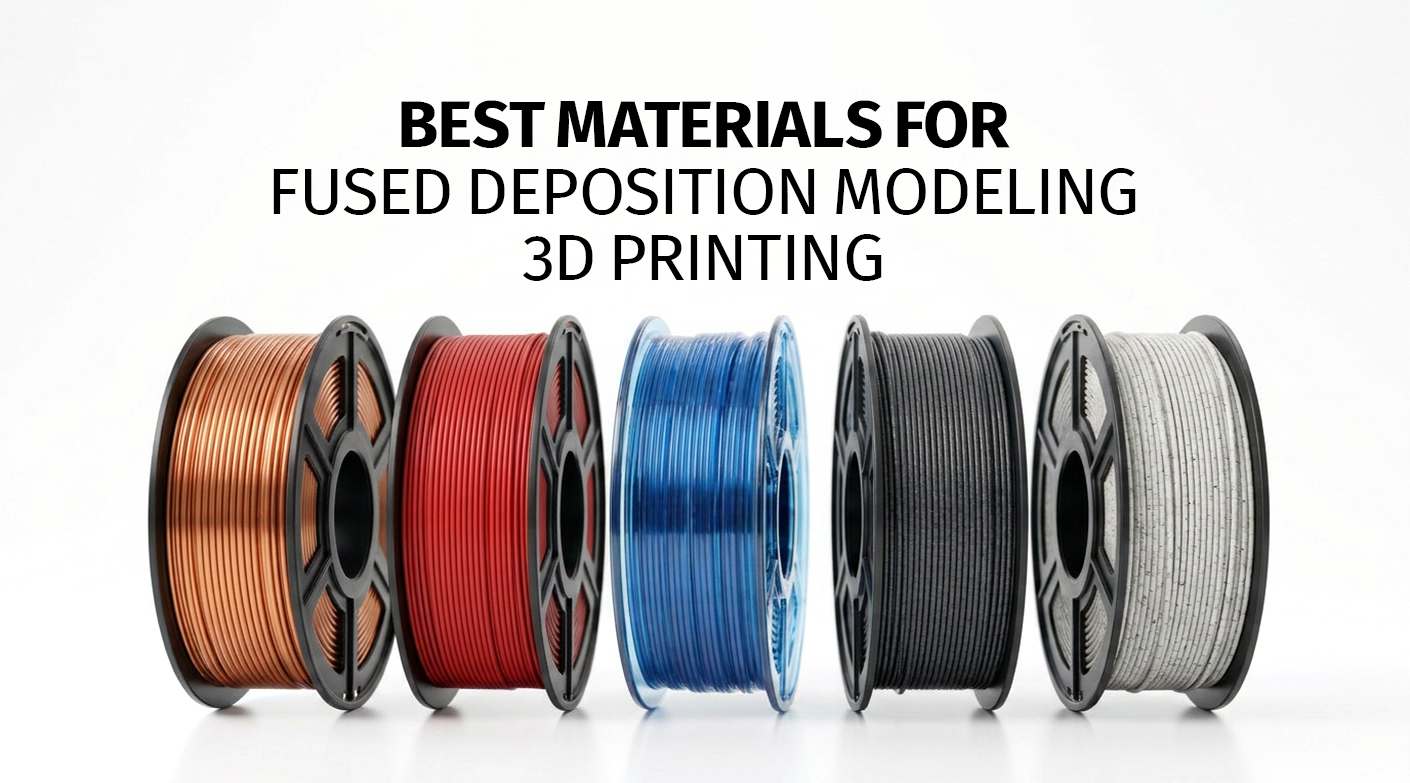
Is the material you use in your 3D printing the correct one? Even if you have a good design as well as equipment and also a seamless printing process, selecting the wrong material can make your part may not function the way you want. That is why selecting the right material is as important as the printing process.
The versatility and ease of access to a variety of engineering-grade thermoplastics make Fused Deposition Modeling 3D Printing one of the most trusted additive manufacturing technologies.
This guide will take you through the best materials for FDM 3D printing, help you understand their pros, and assist you in choosing the right filament for your project.
Understanding Fused Deposition Modeling 3D Printing
Fused Deposition Modeling 3D Printing is an additive manufacturing method that creates objects in layers by extruding thermoplastic filament with the help of a heated nozzle. The printer uses a digital CAD model to add successive layers of material with complete accuracy until the object is made.
The technology is widely preferred because it offers:
- Cost-effective manufacturing
- Fast prototyping
- Functional part production
- Low material waste
- Compatibility with a wide range of engineering thermoplastics
Unlike a number of other additive manufacturing technologies, FDM gives manufacturers the flexibility to strike a balance between cost and function. This suits start-up businesses, product designers, automotive suppliers, industrial manufacturers, educational institutions, and healthcare businesses.
The Role of Material Selection in FDM Printing
People think that the printer quality makes a difference. In reality, material selection often has an even greater impact.
The proper filament determines:
- Mechanical strength
- Heat resistance
- Chemical resistance
- Flexibility
- Surface finish
- Dimensional stability
- Product lifespan
A PLA prototype can be excellent but not resistant to heat, while Nylon or ABS can be very resistant to industrial operating conditions.
A team of experienced engineers, such as those of Cubein, assesses the purpose of the product before suggesting the material. This will not only improve performance, but it will also save on manufacturing costs.
Best Materials for Fused Deposition Modeling 3D Printing
1. Polylactic Acid or PLA
For those who want a material that is easy to process and produces clean and accurate prints, PLA is a good option. It’s one of the most popular materials in FDM 3D Printing, particularly for visual modeling and prototypes.
It is also relatively affordable to print and does not warp much, making it perfect for projects where appearance and dimensional accuracy are more important than mechanical strength.
Why Choose PLA?
- Prints smoothly with very little warping, ideal for beginners and for making detailed prototypes.
- Excellent surface finish, decreases the amount of post-processing and is an inexpensive option for a material.
- A comparatively good choice in terms of being more sustainable, as it is made from renewable materials, which is ideal for concept models and product demonstrations.
2. Acrylonitrile Butadiene Styrene or ABS
ABS is a popular material when appearance is less of a concern than strength and durability. It has been adopted by many manufacturing sectors over the years due to its durability and ability to withstand impact as well as wear and tear.
ABS is commonly used for functional prototypes, machine covers, and consumer products because of its reliable mechanical properties.
3. Polyethylene Terephthalate Glycol or PETG
PETG provides a perfect combination of strength, durability, and printability. It is one of the fastest-growing materials for industrial prototyping. PETG is also favoured by companies for its aesthetics and durability, making it suitable for various applications.
Why Choose PETG?
- Excellent for functional parts as it provides good layer adhesion, is highly durable, and is resistant to chemicals and moisture.
- High impact resistance but easier to print than some engineering high-performance materials.
- It can be used in a variety of industries since it is available in food-safe grades for suitable applications.
Best Applications: Functional prototypes, medical equipment, packaging solutions, protective covers and manufacturing fixtures that need a high degree of durability and a good-looking finish.
4. Nylon or Polyamide
Nylon is a good material for engineering applications requiring high strength and wear resistance. It is highly durable as well as flexible, making it ideal for applications that require repeated motion.
Nylon is commonly used in mechanical components, gears, industrial prototypes, and more, where durability is needed the most.
5. Carbon Fiber Reinforced Filaments
Carbon fibre-reinforced filaments are used in applications that require lightweight but rigid parts. These materials are more dimensionally stable, making them ideal for high-performance industrial applications.
Why Choose This Filament?
- Delivers exceptional stiffness while keeping component weight low for demanding engineering applications.
- Enhances dimensional stability, enabling parts to be used in precision industrial applications.
- Offers increased strength over standard thermoplastic filaments for more sophisticated functional prototypes.
Best Applications: Aerospace parts, automotive parts, industrial tooling, engineering prototypes, and parts that are needed for applications that demand high strength-to-weight ratios.
Applications of Fused Deposition Modeling in 3D Printing
The growing versatility of materials has expanded the applications of Fused Deposition Modeling in 3D Printing.
Some of the most common applications include:
- Rapid product prototyping
- Functional testing
- Manufacturing jigs and fixtures
- Low-volume production
- Consumer product development
- Automotive components
- Medical devices
- Industrial tooling
- Educational models
- Robotics and automation
FDM is also employed in bridge manufacturing by many companies prior to production, which helps lower development costs while providing quick design validation.
How to Choose the Right FDM Material
Choosing the right filament is mainly based on the application of the product instead of selecting the strongest material available.
Consider the following questions:
- Will the part be exposed to high temperatures?
- Does it need flexibility?
- Will it be used outside?
- Is chemical resistance necessary?
- Does the product require a high-quality surface treatment?
- Will it undergo repeated mechanical stress?
- Is weight reduction important?
A professional engineering support can ease this decision by weighing performance requirements and manufacturing costs.
Why Work with an Experienced Fused Deposition Modeling Service Provider?
The additive manufacturing industry continues to expand rapidly. In fact, the additive manufacturing industry globally grew to USD 30.6 billion in 2025, with service providers and materials having seen considerable growth. This underscores the need for more sophisticated material selection and dependable manufacturers. Also, desktop FDM printers are becoming more commonplace, but industrial manufacturing demands more than just loading filament.
A good Fused Deposition Modeling service provider provides:
- Material selection expertise
- Industrial-grade equipment
- Optimised print parameters
- Better dimensional accuracy
- Consistent production quality
- Post-processing support
- Faster turnaround
- Scalable manufacturing solutions
These advantages enable companies to reduce development time and guarantee that prototypes and production components meet expectations.
Conclusion
The key to Fused Deposition Modeling 3D printing is choosing the proper material. Each material has different attributes that impact product performance. Knowing what you want your application to do before selecting your filament is what brings the real difference.
Having someone who has years of experience in the manufacturing industry can help expedite this process, make it more effective, and be much more reliable. Cubein uses state-of-the-art FDM technology, engineering expertise, and an extensive range of industrial-grade materials to create high-quality prototypes and functional parts that meet the needs and challenges of businesses.
| Bring your ideas to reality with the appropriate material for your product. |
FAQs
1. Which material is best for Fused Deposition Modeling 3D printing?
It is not definite to say which is the best material for any project. ABS, Nylon, PETG, and Polycarbonate are good options for functional and engineering components, and PLA is good for prototype development.
2. What industries commonly use FDM printing?
FDM is being used for prototypes, tooling, and end-use parts in a variety of industries, including automotive, aerospace, healthcare, consumer products, education, robotics, and industrial manufacturing.
3. How do I select the right FDM material?
Take into account strength, flexibility, resistance to heat, chemicals, and purpose. A qualified service provider such as Cubein will be able to suggest the best-fit material.
Other Blog
Post-processing for SLS 3D Printed and MJF Parts
Post-processing for SLS 3D Printed and MJF Parts
Read More
Common Mistakes to Avoid When Selecting a Contract Manu...
Common Mistakes to Avoid When Selecting a Contract Manufacturer
Read More
Navigating Low Volume Production in the field of Rapid ...
Navigating Low Volume Production in the field of Rapid Prototyping
Read More
Vacuum Casting Services for High-Accuracy End-Use Parts
Vacuum Casting Services for High-Accuracy End-Use Parts
Read More
Top 6 Advantages of Plastic Injection Molding
Top 6 Advantages of Plastic Injection Molding
Read More