

Reverse Engineering vs Redesign: Cost, Time & Use Cases
What if you have an existing product that works, but could perform better ? Do you recreate it digitally, or redesign it ?
This is where the decision between reverse engineering and redesign becomes important. While both methods canhelp transition an existing physical product into a manufacturable solution, they have different goals.
For businesses evaluating whether to use reverse engineering or redesign, there is no universal answer. The appropriate approach depends on the product’s current state, the desired changes, and the level of development required for the next version.
What is Reverse Engineering?
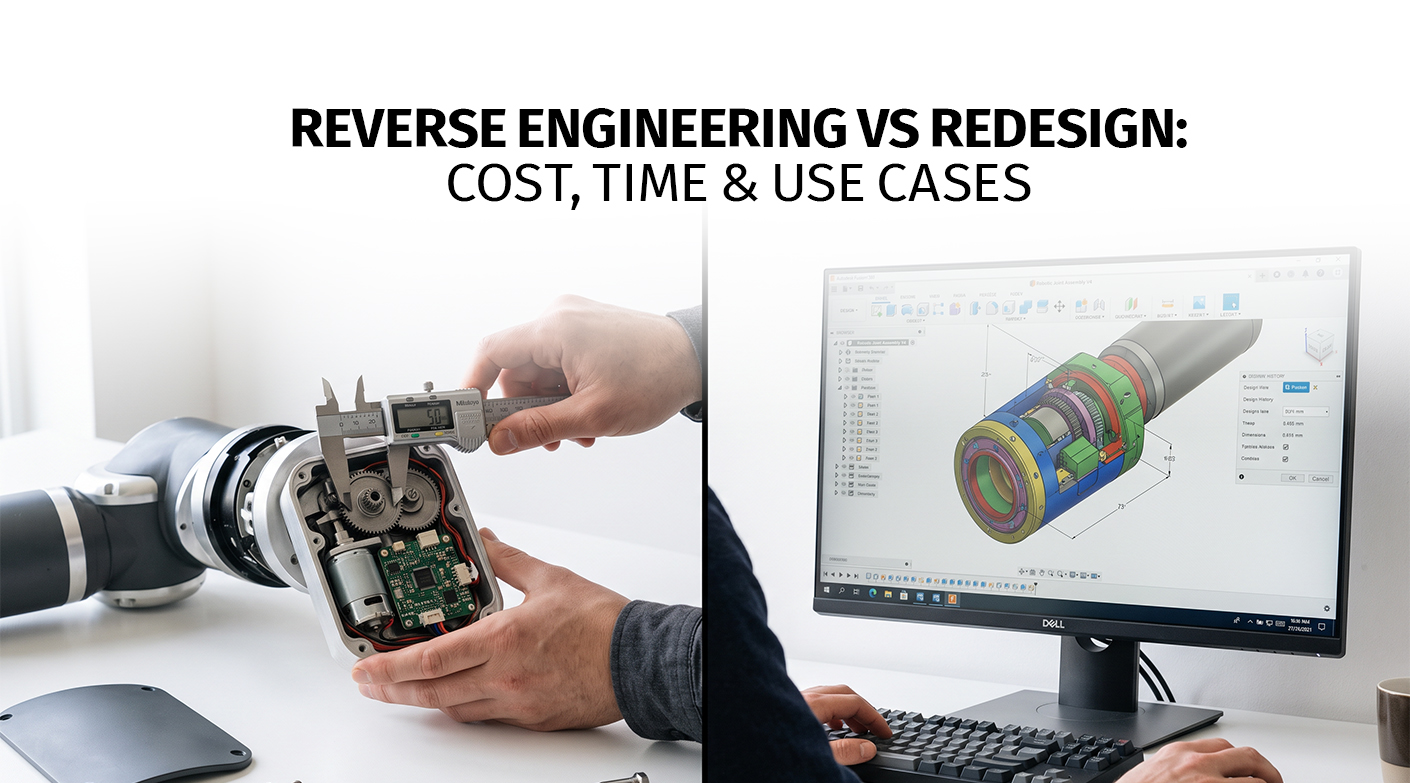
Reverse engineering starts with an actual product, part, or component. Engineers analyse the geometry, dimensions, interfaces, and other features and translate them into a digital CAD model.
This is of great value when original CAD files or technical drawings are not available.
Consider a component that has been in use by a manufacturer for many years, but whose design files are no longer available. The geometry of the part can be analysed and recreated as a digital model using 3D scanning without physically rebuilding the component..
The reverse engineering process is not simply a process that involves copying a product. It involves capturing design data from an actual physical form to help design, edit, prototype or manufacture it digitally.
What is Redesign?
Redesign starts with an existing product but does not aim to replicate it exactly. The aim is to develop a version that better meets specific requirements. These may include adding functionality, changing the form, improving usability, simplifying manufacturing, or adapting the product for a new application.
Typically, a product redesign process involves understanding the existing product, finding where it can be improved, developing the new CAD model, making prototypes, testing, and refining the design based on the results.
For example, Cubein’s industrial design team may design an existing product with new considerations in mind for manufacturability or functionality, and then validate the design through rapid prototyping before transitioning it to production.
The two approaches can also be used together. . A company can first reverse engineer an existing product and then redesign selected components to meet new requirements.
Two Factors To Consider For Reverse Engineering vs Redesign
1. Cost
Cost is a significant factor when evaluating the difference between the two approaches.
When the objective is simply to recreate a part for which CAD models are unavailable ; then reverse engineering is more economical. The physical product gives engineers a direct reference, so there might be fewer conceptual developments.
Redesign can involve higher development costs because it may require conceptualisation, modelling, prototyping, testing, and refining.
But it’s not all about the initial development cost. If a change to the design helps make the product more manufacturable or removes recurring product issues, this helps achieve some cost savings later in the product life cycle.
The more relevant question is therefore not simply which approach costs less, but which approach reaches the required outcome without unnecessary development.
2. Time
Using reverse engineering can be an advantage when time is critical and the existing product already meets most of the requirements.
The physical product serves as a direct reference, reducing the need to develop each element.
When significant changes are needed, redesign may take longer, because each change can involve more CAD development, prototyping, testing, and iteration.
But the fastest first prototype doesn’t necessarily mean the fastest path to production.
According to PwC’s study, Digital Product Development 2025, which surveyed 200 decision-making executives from industrial organisations. They believe digital product development will bring about an average of 19% efficiency gain, 17% time-to-market reduction, and 13% production cost reduction over the next 5 years.
This highlights why efficient design iteration and prototyping can be as important as the initial development pace.
When Should You Choose Reverse Engineering?
Reverse engineering is particularly useful when an existing physical product contains most of the information required to recreate or understand it digitally.
It can be appropriate when:
- Original CAD files or drawings are unavailable
- A physical component needs to be converted into a digital CAD model
- Existing geometry needs to be digitally reproduced for further development
- Digital capture is required for complex or freeform geometries.
- An existing component needs to be understood before modification
- A physical product needs to progress toward prototyping or manufacturing
Once the product has been digitally recreated, engineers can determine whether further modifications are needed.
When Does Redesign Make More Sense?
Redesign becomes more appropriate when the existing product no longer meets its intended functional or manufacturing requirements.
This may occur when the product needs to be adapted for a new application, its shape or function requires improvement,or manufacturing requirements have changed.
In such cases, simply reproducing the original product may not address the underlying requirement.
The product redesign process uses the existing product as a reference while giving designers the flexibility to come up with a better solution.
Can Reverse Engineering and Redesign Work Together?
Yes. In many projects, the two approaches are used as complementary methods, not competing ones.
Suppose a manufacturer has an older physical component and no CAD data to work with. First, reverse engineering can be used to create an accurate digital model. In this model, designers are able to modify its geometry, add individual features, or adapt it for a different application.
This workflow can progress from the physical product to reverse engineering, CAD development, redesign, prototyping, and finally manufacturing.
This approach can be particularly useful when the existing product already has a strong foundation and only some improvements are required.
Reverse Engineering vs Redesign: The Bottom Line
So, reverse engineering vs redesign: which approach is appropriate? The answer depends on the product requirements and development objectives.
Reverse engineering is used to recreate, understand, or preserve a real physical product in a digital form. When the product requires significant changes or is modified to meet new requirements, use redesign.
In some cases, both approaches can be used together. . Reverse engineering establishes a digital foundation, while redesign can build on that foundation to address new requirements..
The key is to align the approach with the product’s development requirements. Cubein combines industrial design, reverse engineering, rapid prototyping, low-volume manufacturing, and injection tooling and production into a single solution to help businesses translate their product and ideas into manufacturable solutions.
| Ready to take your existing product to the next level? |
FAQs
1. What is the difference between reverse engineering and redesign?
Reverse engineering digitally recreates a physical object; redesign changes the product or makes it better for new requirements.
2. How does prototyping help in product redesign?
Prototyping involves building a physical model to test and refine the design before production.
3. How do you select an industrial product design company?
Identify a partner with relevant design, reverse engineering, prototyping, and manufacturing skills to facilitate the entire product development process.
Other Blog
Top 6 Advantages of Plastic Injection Molding
Top 6 Advantages of Plastic Injection Molding
Read More
High Quality, Reliable, Quick 3D Printing Services in B...
High Quality, Reliable, Quick 3D Printing Services in Bangalore
Read More
The Ultimate Guide to Low-Volume Injection Molding
Injection molding monopolized high-volume manufacturing in the 1940’s.
Read More
How are Original Design Manufacturers (ODMs) in India S...
How are Original Design Manufacturers (ODMs) in India Supporting Startups?
Read More
Materials Used in Selective Laser Sintering 3D Printing...
Materials Used in Selective Laser Sintering 3D Printing Explained
Read More
Original Design Manufacturer: Reducing Risk in Product ...
Original Design Manufacturer: Reducing Risk in Product Launches
Read More
Common Product Design Mistakes and How to Avoid Them
Common Product Design Mistakes and How to Avoid Them
Read More