


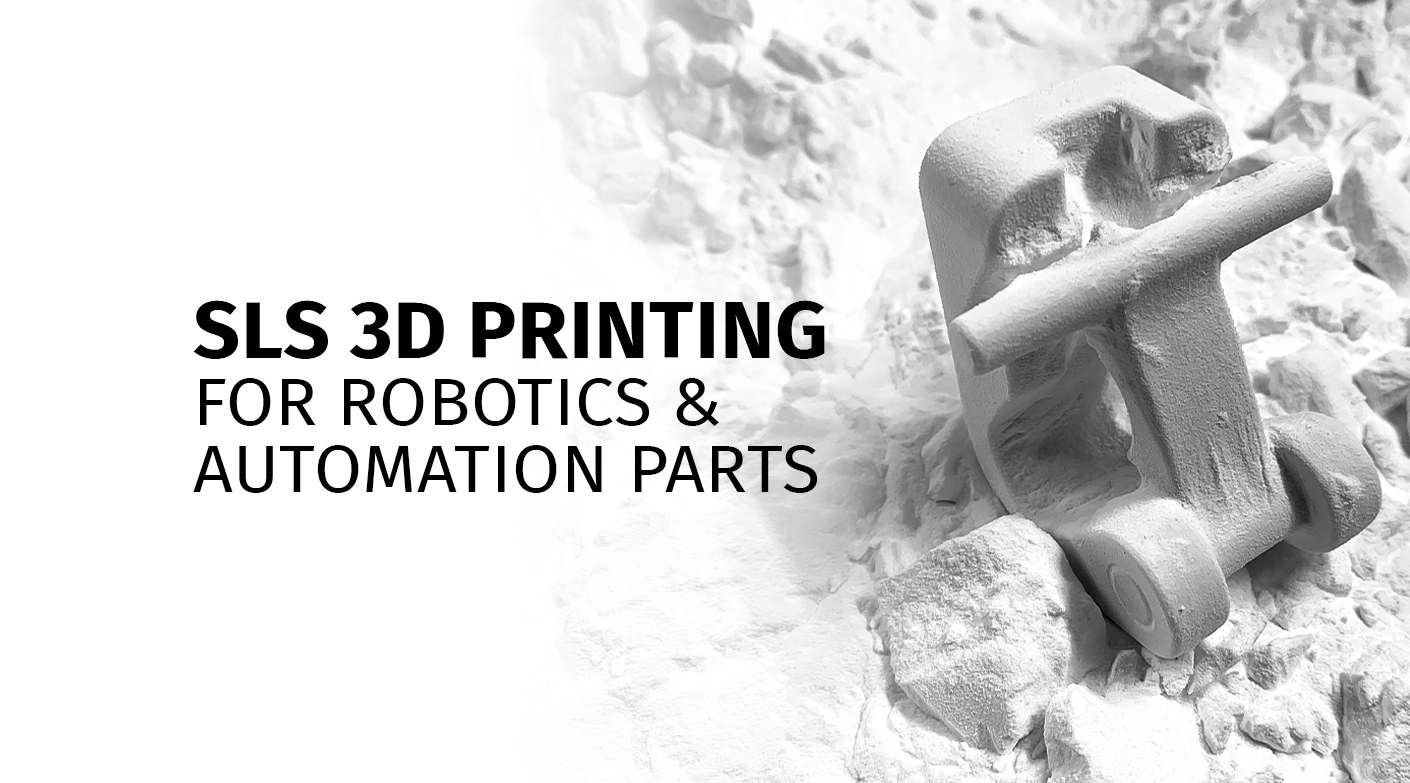
“Why are leading robotics companies replacing traditional manufacturing with SLS 3D printing?”
The solution is simple: the evolution of robotics and automation systems is increasing at a faster rate than the production systems. In these modern times, robots are expected to become smarter and more compact. Common methods like CNC machining as well as injection molding often fall short of achieving this flexibility at the same cost and lead time.
This is where SLS 3D printing for robotics is transforming industrial manufacturing. Selective Laser Sintering (SLS) enables manufacturers to design and produce automation parts with a high degree of freedom, function, and lightness. From robotic grippers to sensor housings, drone frames to custom automation fixtures, engineers can quickly move from concept to production with SLS technology without the restrictions of traditional tooling.
With the rise of industrial automation and smart manufacturing, enterprises are seeking an efficient and dependable selective laser sintering 3D printing services provider like Cubein to enhance product development, decrease manufacturing complexity, and improve operational efficiency.
Let’s know about how SLS technology is reshaping robotics manufacturing.
Understanding SLS 3D Printing and Its Role in Robotics
The technique, Selective Laser Sintering (SLS), is a high-technology additive manufacturing process that fuses powder materials, layer-by-layer, into fully functional parts using a powerful laser beam. SLS produces parts from a digital CAD file, in contrast to subtractive manufacturing processes that cut material from a solid block.
One of the most significant benefits of SLS 3d printing technology is that no support structures are needed during printing. The surrounding powder naturally supports the component during the building process. This enables manufacturers to produce geometries that are not feasible using conventional manufacturing processes.
This is a very useful feature for robotics and automation systems. With a single manufacturing step, engineers can create lightweight structures, internal channels, integrated assemblies, and compact components without complex assembly processes.
Another advantage of SLS is that, unlike conventional manufacturing methods, it allows the production of a complete functional component as a single part. This also reduces the likelihood of failure at specific stages of assembly, improving the reliability of robotic systems.
Why Robotics and Automation Demand Advanced Manufacturing
Today’s robotic systems are not only strong but also advanced. Components must also deliver:
- Lightweight performance
- Dimensional accuracy
- Heat and chemical resistance
- Fast prototyping capabilities
- Design flexibility
- Low-volume production efficiency
Tools such as CNC and injection molding can be costly and time-consuming, particularly during the iterative design process.
Robotics companies today operate in an environment where rapid testing and faster deployment directly affect competitiveness. Engineers create several design iterations before finishing a robotic system. Each iteration can introduce weeks of delay and expense with traditional tooling.
That is why manufacturers are increasingly collaborating with specialist 3D printing companies like Cubein that specialise in SLS to reduce innovation cycles.
How SLS 3D Printing Supports Robotics Manufacturing
1. Lightweight Yet Strong Parts
Weight reduction is such an important factor in robotics. Heavier components result in higher energy consumption and lower efficiency.
With SLS, lightweight constructions and hollow bodies can be produced without compromising structural strength. This increases the speed, precision, and energy efficiency of the robot.
Weight reduction can further enhance the motion control and operational life of robotic arms, drones, AGVs (Automated Guided Vehicles), and collaborative robots.
2. Complex Geometries Without Assembly
The internal channels, cable paths, sensor mounts, and moving elements in robotics components can be highly complex.
The traditional manufacturing process often involve assembling multiple parts together. With SLS, it is possible to create such geometries in a single solid body.
This offers several advantages:
- Reduced assembly time
- Lower failure points
- Improved durability
- Better dimensional consistency
- Reduced inventory complexity
For instance, pneumatic systems can be integrated into robotic grippers as a single part using SLS technology.
3. Accelerate Prototype Development for Robotics
Robotics manufacturers continually improve their designs. An SLS prototype machine creates functional parts without the need for costly molds or tooling. Design changes in the design can be made to the CAD file, significantly reducing development times.
This flexibility is extremely useful for startups and R&D teams developing custom automation systems. That is why companies depend on Cubein, a trusted selective laser sintering 3D printing services provider, to swiftly move from prototype validation to practical testing without delays in production.
Industrial Applications of SLS in Robotics and Automation
In many fields of robotics and automation, SLS technology is being adopted because of its ability to produce functional and performance-oriented parts.
#1 Robotic Grippers
One of the most popular applications is robotic grippers. Nowadays, the demand for lightweight yet durable designs has increased. With SLS, manufacturers can optimise both factors simultaneously.
#2 Autonomous Vehicle Components
SLS manufacturing is also highly advantageous for creating autonomous guided vehicles. Lightweight structural components enhance battery efficiency and operability without compromising mechanical reliability.
#3 Drone Components
Aerodynamic frames, sensor mounts for sensors, and enclosures are common applications of SLS in the drone manufacturing sector. The advantage of SLS lies in its ability to reduce weight, makeing it ideal for balancing performance and durability in drones.
#4 Industrial Fixtures and Jigs
SLS is also used for the production of jigs, fixtures, and custom tooling for industrial automation systems. Using traditional manufacturing techniques to create customised production tools can be costly and time-intensive. With SLS, customised solutions can be produced quickly for special assembly or positioning tasks.
The Future of SLS in Robotics and Smart Manufacturing
The future of robotics manufacturing is becoming increasingly connected with advanced additive manufacturing technologies. As automation systems become smarter and more customised, traditional production methods may struggle to meet constantly evolving design requirements.
As a matter of fact, over 5 lakh industrial robots were installed around the world in 2024, and over 4.6 million industrial robots are already in use. The numbers clearly indicate that additive manufacturing is no longer an experimental process.
SLS technology is expected to play a major role in:
- Optimisation of AI robotics designs
- Digital manufacturing workflows
- Lightweight autonomous systems
- On-demand industrial spare parts
- Smart factory automation
Thus, technologies like SLS are becoming an essential part of industrial production strategies.
Conclusion
The expectations of manufacturing are changing in every industry, with the advent of industrial automation and robotics. Businesses are looking for production solutions that are fast, precise, and not limited by conventional tooling techniques.
That’s why SLS 3D printing for robotics is becoming an increasingly valuable manufacturing solution. It has become essential for next-generation industrial innovation.
Cubein offers state-of-the-art additive manufacturing capabilities and industrial-grade SLS solutions designed for robotics and automation. At Cubein, high-performance engineering applications help businesses turn automation ideas into reality.
| Looking to speed up your robotics innovation with SLS printing? |
FAQs
1. Why is SLS 3D printing useful for robotics?
In contrast to conventional manufacturing techniques, SLS allows manufacturers to create highly complex robotic parts while avoiding the limitations of tooling. It also facilitates rapid prototyping and even faster production cycles.
2. What materials are commonly used in SLS for automation parts?
The nylon materials like PA12 are commonly used due to their excellent strength, heat resistance, and dimensional stability in industrial applications.
3. Is it possible to produce working end-use robotics components with SLS?
Yes. SLS technology can produce fully functional parts for industrial robotic systems, automation equipment, and custom machinery applications.
4. Why should businesses choose a professional SLS 3D printing company?
For critical automation parts, an experienced provider ensures superior print accuracy, material optimisation, engineering support, and reliable production quality.
Other Blog
The Role of Industrial Design in Smart Home Product Dev...
The Role of Industrial Design in Smart Home Product Development
Read More
Exploring Popular Applications of Fused Deposition Mode...
Exploring Popular Applications of Fused Deposition Modeling in 3D Printing
Read More
What Should I Know Before Getting An Injection Molding ...
What Should I Know Before Getting An Injection Molding Quote?
Read More
Materials Used in Selective Laser Sintering 3D Printing...
Materials Used in Selective Laser Sintering 3D Printing Explained
Read More
High Quality, Reliable, Quick 3D Printing Services in B...
High Quality, Reliable, Quick 3D Printing Services in Bangalore
Read More
Why Startups Need an Industrial Product Design Company ...
Why Startups Need an Industrial Product Design Company in India?
Read More