


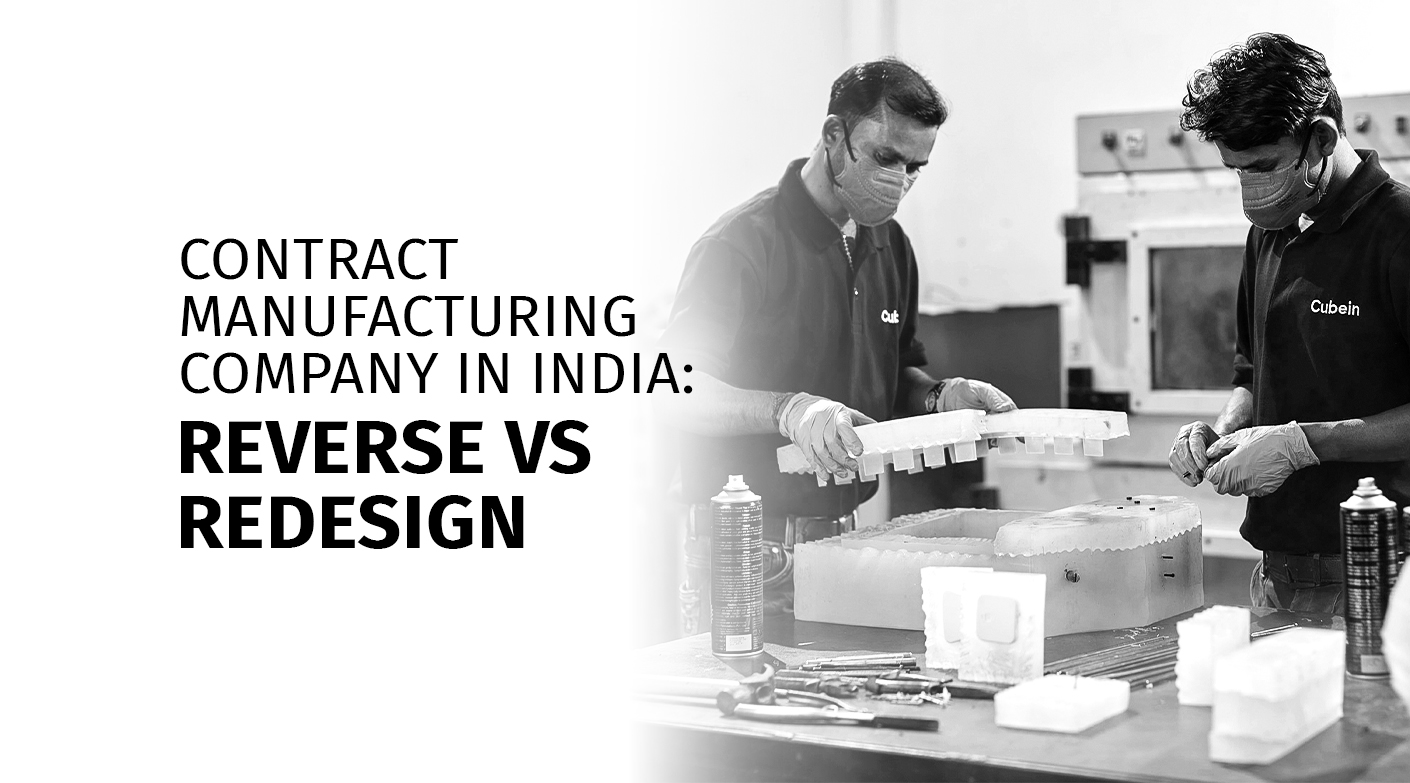
Suppose your next product could enter the market twice as fast, or stand out so much that your competitors face a hard time catching up? That’s the power of choosing the right manufacturing strategy. A contract manufacturing company in India is no longer just serving as an outsourcing firm to produce goods and services. Rather, businesses today are using a contract manufacturing company in India as a strategic resource to shape their speed, cost, and market identity.
The key point in this decision is a critical comparison: Reverse vs Redesign. One is concerned with speed and replication, whereas the other is concerned about innovation and differentiation. To gain the maximum benefit of the modern contract manufacturing solutions, you need to understand both.
Let’s take a deep dive into contract manufacturing and compare Reverse vs Redesign methods.
The Rise of Contract Manufacturing Services in India
India has evolved into a global manufacturing powerhouse, attracting startups, SMEs, and multinational brands alike. It is not just about cost savings but also about flexibility, technical expertise, and scaling up within a short period.
This growth is reflected in market data. It is estimated that the contract manufacturing market in India will grow by a CAGR of over 14 percent. This rise is a reminder of how businesses are becoming more and more dependent on contract manufacturing services in India, not only to produce but also to gain a strategic advantage.
Understanding Reverse and Redesign Manufacturing
1. Reverse Manufacturing
Reverse manufacturing, also referred to as reverse engineering, is about deconstructing an existing product and recreating it. It enables companies to penetrate markets within a short period due to already functioning designs.
Rather than spending months or years to develop a new product, companies duplicate the components, materials, and functionality of an existing product and make slight improvements or cost cuts.
This strategy is especially effective when a category of products has already been proven in the market. For example, a number of consumer brands enter the market offering competitive options, having studied best-selling products and offering them with similar performance but at a lower price point.
There are a number of major advantages that make reverse manufacturing appealing:
- It saves a lot of time in development
- It lowers R&D cost
- It reduces the market risk because the demand has already been created
Nevertheless, it has its own shortcomings, particularly in terms of uniqueness and brand differentiation.
2. Redesign Manufacturing
In contrast to reverse manufacturing, redesign begins anew, at least in a new vision. It is aimed at finding the gaps in the current products and developing something more, smarter, or user-centric.
Redesign is not just a matter of the design; it is frequently a matter of functionality, making the design more user-friendly or incorporating new technologies. This is a longer, more expensive, and more know-how-intensive process, but the reward may be high.
Businesses that opt to redesign are usually trying to create a powerful brand identity. They’re not just competing; they’re redefining the category.
Redesign manufacturing enables companies to:
- Create unique, differentiated products
- Build intellectual property
- Target premium or niche markets
Although it requires greater initial investment, it can also provide greater long-term value.
Reverse vs Redesign: Core Differences
| Factor | Reverse Manufacturing | Redesign Manufacturing |
| Development Time | Short | Longer |
| Cost | Lower | Higher |
| Innovation | Limited | High |
| Risk | Low | Moderate to High |
| Market Entry | Fast | Strategic |
| Brand Value | Moderate | High |
In simple terms:
- Reverse = Speed & Cost Efficiency
- Redesign = Innovation & Differentiation
Choosing the Right Strategy for Your Business
Reverse vs Redesign will depend on your business objectives, budget, and market position.
Choose Reverse if:
- You desire rapid entry into the market
- The budget is limited
- Demand is already validated
- You are building a private label
Choose Redesign if:
- You aim to innovate
- You desire long-term brand equity.
- You are focusing on high-end customers
- You require IP ownership
A smart contract manufacturing company in India usually integrates the two, Reverse first and later on Redesign.
Hybrid Approach: The Best of Both Worlds
Numerous thriving brands do not pick one strategy; instead, they combine both.
Step-by-Step Hybrid Model:
- Begin with reverse manufacturing as an easy entry point
- Analyse customer feedback
- Introduce redesign improvements
- Develop a differentiated product line
This approach balances:
- Speed
- Cost
- Innovation
It is among the best Contract Manufacturing Solutions for scaling businesses.
Benefits of Contract Manufacturing Services in India
Collaborating with a contract manufacturing company in India has several benefits that extend beyond production.
The manufacturing ecosystem in India is designed to be efficient and flexible. Without investing heavily in capital, businesses are able to either increase or decrease production according to demand. Such flexibility comes in especially handy in any industry where the market trends are changing.
Also, Indian manufacturers provide the availability of qualified engineers, new technologies, and developed supply chains. This implies that the businesses can concentrate on the major activities such as branding, marketing, and customer acquisition, whereas the production is done by the experts.
The other significant advantage is that it has a quicker time-to-market. Regardless of whether you are choosing reverse or redesign, the right manufacturing partner will help to make the process much faster.
Challenges You Should Not Ignore
As convincing as the advantages are, a well-defined approach must be taken towards contract manufacturing services in India.
- Quality control may be a problem when the manufacturer is not properly certified or approved.
- Protection of intellectual property is yet another important aspect, particularly when undertaking a redesign project.
- Timelines can also be affected by communication gaps and supply chain disruptions in case they are not managed effectively.
These issues do not eliminate the advantages, but they emphasise the need to select the right partner.
Conclusion
Reverse vs Redesign depends entirely on your business vision. When you are focused on speed and cost-efficiency, reverse manufacturing provides a viable beginning point. Redesign is the solution if innovation and long-term brand value are your goals.
However, the most successful businesses do not just stand still; they evolve, merge, and develop. The collaboration with the appropriate contract manufacturing company in India will help to make this journey more efficient and effective.
With the proper expertise and strategic approach, companies such as Cubein assist in turning ideas into scaled, market-ready products. At Cubein, whether through reverse engineering, redesign, or a potent combination of both, we help you design your products.
FAQs
1. What is a Contract Manufacturing Company in India?
It is a company that can produce products on behalf of other brands, allowing businesses to outsource production and concentrate on growth, branding, and distribution.
2. What is the difference between Reverse vs Redesign?
Reverse is used to duplicate the existing products, and redesign is concerned with the production of new or improved products with distinctive characteristics and innovation.
3. Which strategy is better for startups?
Startups find reverse manufacturing to be quite cost-effective and fast to market before transitioning to redesign for differentiation.
Other Blog
Original Design Manufacturers in India for Automotive I...
Original Design Manufacturers in India for Automotive Innovation
Read More
Design Tips for FDM (Fused Deposition Modeling) 3D Prin...
Design Tips for FDM (Fused Deposition Modeling) 3D Printing Parts
Read More
Additive Manufacturing in Military and Defence Industry...
Additive Manufacturing in Military and Defence Industry Applications
Read More
The Role of Industrial Design in Smart Home Product Dev...
The Role of Industrial Design in Smart Home Product Development
Read More
What is SLS 3D Printing? Explore SLS 3D Printing Applic...
What is SLS 3D Printing? Explore SLS 3D Printing Applications
Read More
Low-Volume Manufacturing in 2025: Demand for Customizat...
Do you know what’s the common thread connecting Porsche’s sports car seat, Rolls Royce’s brackets, a
Read More
What Should I Know Before Getting An Injection Molding ...
What Should I Know Before Getting An Injection Molding Quote?
Read More