

Design Tips for FDM (Fused Deposition Modeling) 3D Printing Parts
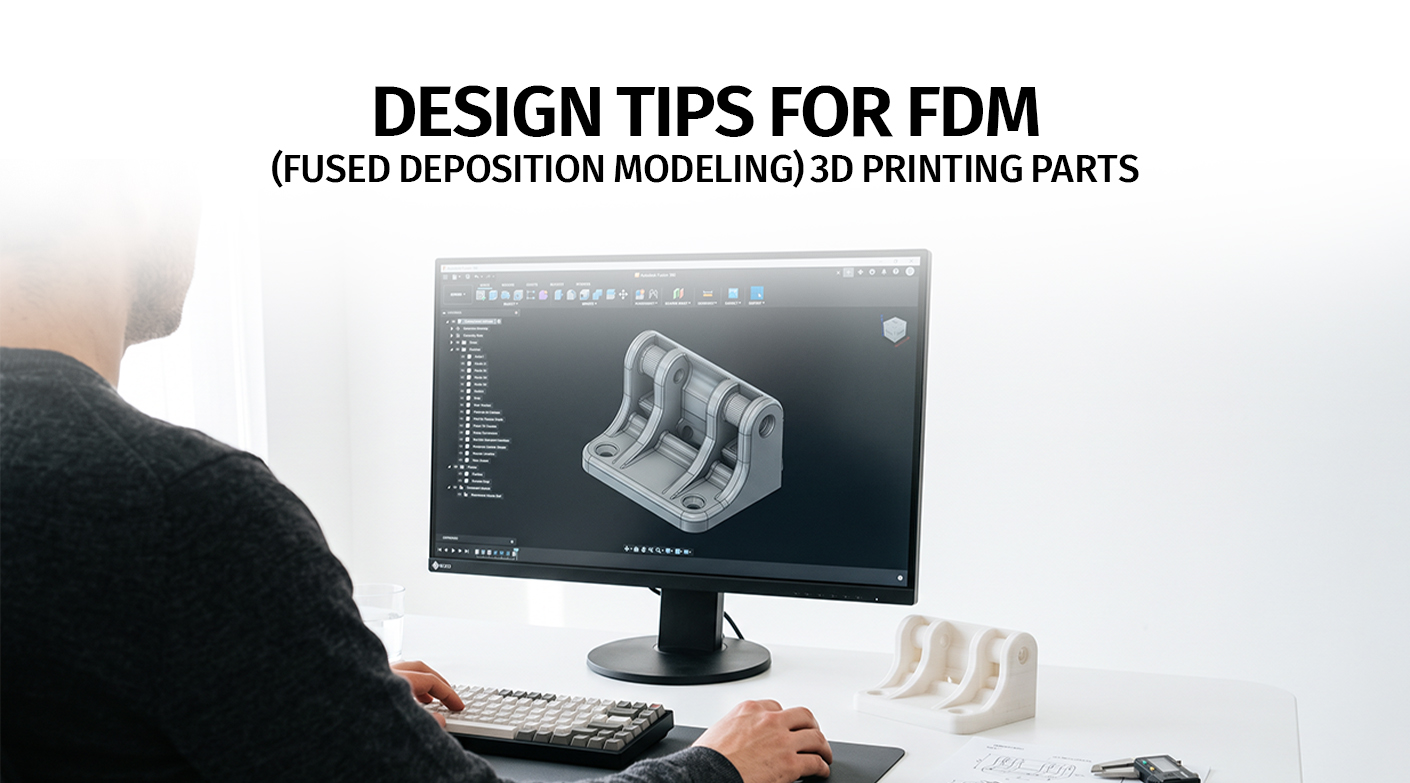
So what turns a good CAD model into a successful FDM 3D-printed part? It is not simply about creating a precise digital model and printing it. Since parts are printed layer by layer, a part’s design can directly affect its printability, strength, appearance, and functionality when using FDM (Fused Deposition Modeling).
For businesses that are creating physical products, these factors are particularly relevant in the rapid prototyping process. The goal is not just to create a model, but to develop a prototype that can be used to assess the product’s form, fit, function, and performance of the product before moving further into development.
Among prototyping technologies such as SLA, SLS, DLP, and vacuum casting, FDM is a widely used option. Let’s explore some design tips for FDM 3D printing parts.
The Significance of Design in FDM 3D Printing
An efficient prototyping process starts with a design that is optimised for FDM. Because the process deposits thermoplastic material layer by layer, certain geometric considerations are more important than they would be in conventional manufacturing.
The final prototype can be affected by poorly planned overhangs, very thin sections, inappropriate orientations, or complex unsupported features. However, a design that takes into account the manufacturing process can minimise needless complications and simplify the assessment of the product. This is particularly relevant when using rapid prototyping to test a product before production.
The rapid prototyping services offered by FDM 3D printing service providers such as Cubein enable businesses to create physical prototypes from CAD data whether they meet the intended aesthetic and functional goals.
8 Design Tips for FDM (Fused Deposition Modeling) 3D Printing Parts
1. Choose the Right Printing Orientation
One of the first things to consider when preparing an FDM design is part orientation. The direction of the layers can affect the component’s surface appearance and mechanical properties because of the way FDM builds parts layer by layer. Orientation may also influence the amount of support required and the overall printing process.
In the case of functional prototypes, think about how the part will be used and where mechanical forces will be applied. Position critical features based on their functional requirements, not just their appearance.
2. Keep Wall Thickness Practical
Very thin walls can be hard to produce consistently, while unnecessarily thick walls can increase material usage and production time.
Wall thickness depends on the part’s function, form, material and performance requirements. Requirements for a prototype intended primarily for design evaluation may differ from those for a prototype used for functional testing.
3. Design Overhangs Carefully
In FDM, overhangs can be challenging because each successive layer requires support from the underlying material.
Unsupported large areas can lead to rough surfaces or print failures. In addition to support structures, designers can improve printability by incorporating angled surfaces, chamfers, or smooth transitions.
For complex geometries, it may be better to consider alternative orientations or manufacturing technologies rather than trying to accommodate every feature in a single FDM orientation.
4. Consider the Application Before Selecting the Material
Each thermoplastic material offers different characteristics, so material selection should be based on the requirements of the prototype. General form and fit can be evaluated separately from functional performance.
Material considerations should therefore be addressed along with the design, orientation and testing requirements, rather than as a last step.
5. Pay Attention to Small Features
CAD software enables designers to create very small holes, slots, text and other details. However, a feature that appears clearly defined on a digital model may not always be as clearly defined in the FDM prototype.
Therefore, designers need to determine which features are functionally critical and which are primarily cosmetic. Particular attention should be given to critical interfaces, mounting positions, and mating features, as dimensional deviations from the design can influence the mating characteristics of parts.
As precision requirements increase, the appropriate prototyping technology should also be taken into consideration. FDM is not the only available solution out there; SLA, SLS, DLP, vacuum casting, and CNC machining can all be used for different prototyping requirements.
6. Consider Assembly in Design
A prototype is not usually a stand-alone product. It may have to fit with another part, exhibit a specific mechanism, or be tested as part of a larger product.
Therefore, it is important to take the assembly requirements into account during the design phase. Clearances, mating surfaces, mounting points and interfaces should be checked before the prototype is built.
This is especially helpful if the prototype is for functionality or compatibility testing. Rapid prototyping can help designers test these elements, collect feedback, identify areas for improvement and make more design changes before moving into production.
7. Match the Technology to the Prototype’s Purpose
Knowing when to use FDM (Fused Deposition Modeling) 3D printing and when another process may be more suitable is an important part of effective prototyping.
FDM is well suited to rapid prototyping when thermoplastic structure and the required degree of detail are appropriate for the project. However, other technologies may offer advantages for specific requirements.
The comparison between SLA vs FDM 3D printing is therefore not about identifying one universally superior process. If the prototype needs to have properties that are not provided by FDM, then SLA may be used. Likewise, SLS, DLP, vacuum casting, or CNC machining may be more suitable depending on the design and validation requirements.”
8. Use Prototypes to Test the Design
One of the key benefits of outsourcing 3D printing to an FDM service provider is that the physical prototype can form part of a larger product development cycle.
Rather than relying solely on a digital model, businesses can evaluate the physical prototype, test its compatibility, receive feedback, and determine what could be improved.
This is more than just a visualisation exercise; it’s a practical step in the prototyping process.
Applications of Fused Deposition Modeling in Prototyping
The applications of Fused Deposition Modeling are closely connected to product development and rapid prototyping. FDM is suitable for situations where physical prototypes are required to test product concepts. Also, the global FDM market is projected to grow at a CAGR of 23.5% (2026-2033).
Rapid prototyping is especially useful when the first iteration of a product needs to be reviewed, design feedback is required, multiple iterations need to be tested, or the functionality of a product component needs to be evaluated.
Conclusion
The key difference between a 3D-printed object and a useful product-development prototype lies in designing specifically for FDM. Before production, consider orientation, wall thickness, overhangs, material selection, small features, assembly requirements, and technology selection.
Cubein combines industrial design and rapid prototyping with FDM, SLA, SLS, DLP, vacuum casting and CNC machining. Its integrated approach enables and test prototypes before progressing to low-volume production, injection tooling, and full-scale production if needed.
| Take your concept from CAD to a functional prototype faster with Cubein. |
FAQs
1. What is the most important design consideration for FDM printing?
Part orientation is one of the most significant factors to consider, as it can affect mechanical strength, surface quality, and support requirements.
2. What are the applications of FDM?
Rapid prototyping may be performed with the FDM, for example, when testing concepts, functions, compatibility and design variations.
3. Is FDM better than SLA for prototyping?
The appropriate technology depends on the prototype’s design, testing requirements, material, and desired properties.
4. Why are FDM 3D printing services useful for product development?
They enable businesses to create a physical prototype from a CAD design that can be assessed, tested, and optimised before moving forward with production.
Other Blog
Why Choose Vacuum Casting for Medical Products?
Why Choose Vacuum Casting for Medical Products?
Read More
SLS 3D Printing for Robotics and Automation Parts
SLS 3D Printing for Robotics and Automation Parts
Read More
Original Design Manufacturers in India for Automotive I...
Original Design Manufacturers in India for Automotive Innovation
Read More

The Ultimate Guide to Low-Volume Injection Molding
Injection molding monopolized high-volume manufacturing in the 1940’s.
Read More