


What is Short Run Injection Molding? Benefits and Use Cases
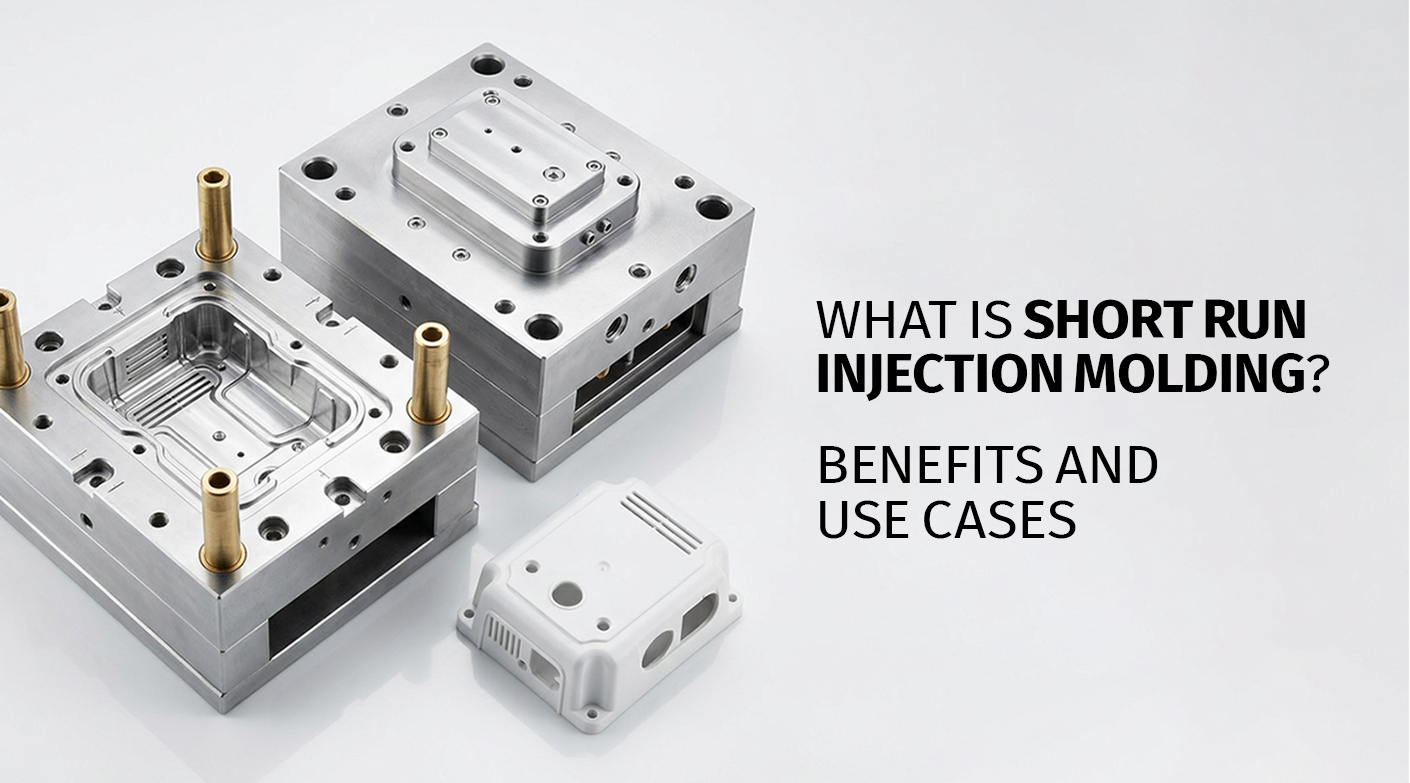
Do you need high-quality plastic components in limited quantities? In the case of a new product, a new design, or a new product launch, large production might not be the best place to begin.
This is where short-run injection molding can be useful. It produces limited quantities of plastic parts that have the same dimensions, tolerances, and properties.
Short-run production can support product development teams evaluating prototypes as well as large manufacturing companies creating special parts. It allows businesses to assess with designs, reduce the upfront manufacturing expenses, and make decisions before they speed up manufacturing.
Short Run Injection Molding: How Does It Work?
Short run injection molding is a manufacturing process involving the production of a small amount of plastic parts in an injection mold. While conventional injection moulding is often associated with high-volume production, short runs can support product development, low-volume manufacturing, and specialised applications.
It is the process of melting plastic material under high pressure and injecting it into a mould, cooling, and taking out the product from the mould. The cycle is repeated until the desired number of units are produced.
It is a very suitable solution for businesses that need functional plastic components but are not prepared to make a big investment in the production process.
How does it work? Well, the process involves several stages to ensure that the finished components meet the required specifications.
1. Product Design and Development
The process begins with a CAD model or product design. Engineers evaluate the component’s geometry, wall thickness, material requirements, and intended application to determine its suitability for injection moulding.
Design for Manufacturing (DFM) helps identify potential problems before tooling commences.
2. Mold Design and Preparation
A mould is designed and prepared based on the specification of the component. The initial investment in tools depends on factors like the complexity of the material and its expected life.
Tooling costs are an important consideration in short production runs, as the initial investment must be assessed against the required production quantity.
3. Material Selection and Injection
The plastic material is selected based on the component’s mechanical strength, impact resistance, and intended use. The material is then melted, injected into the mould, cooled, and ejected to form the component.
4. Inspection and Production
Finished components are inspected for dimensional accuracy, surface quality, and functional performance. Once the first parts are produced and pass the required specifications, the remaining parts can be manufactured and tested.
Key Benefits of Short Run Injection Molding
1. Lower Initial Production Commitment
Producing a smaller batch can help reduce the risk of overproduction. This is very helpful if the demand is not predictable or perhaps if customer feedback can impact future design decisions.
Although additional tooling is required, limited production can be implemented to help control inventory and prevent overproduction.
2. Consistent Quality and Precision
One advantage of injection moulding is its ability to produce consistent components. Once the mould and the processing parameters are determined, the same design can be replicated throughout the batch.
It can be useful when the parts need to be joined together to form an assembly or an object that performs a certain function.
3. Faster Product Validation
Short-run production allows businesses to evaluate actual moulded components before increasing production volumes. Teams can evaluate the usability and appropriateness of the materials, assembly compatibility and appropriateness of the design.
The findings can inform design improvements and production decisions to enhance results prior to investing a lot more in the technology.
4. Cost Efficiency for Suitable Projects
In terms of per-unit costs, injection molding may be a more appealing option than large amounts of machining or manual work. The economics are based on tooling cost, material used, part complexity, and quantity.
Short-run production does not always deliver the lowest per-unit cost. However, it can help businesses limit their initial production commitment while manufacturing components to the required quality standards.
5. Flexibility in Product Development
Businesses can try a product before mass producing it, providing feedback and making changes to the design. This flexibility is especially helpful in the case of new parts and products that require further development.
Common Use Cases of Short Run Injection Molding
Short-run injection molding can be suitable for manufacturers requiring plastic parts for small production quantities, irrespective of the business or industry.
1. Product Development and Testing
Manufactured components can be used to test and prove engineering designs. These components are used to evaluate the properties of the material, assembly fit, and function before approving the part design for mass production.
2. New Product Launches
Businesses launching a new product might not be able to gather enough knowledge about sales to begin mass production. Having a smaller initial purchase helps them determine how much they need, without overstocking.
3. Specialised Industrial Components
Short-run molding can be appropriate for components like equipment housings, covers, brackets and connectors, as long as their design and use are suitable for the material and molding process.
4. Replacement Parts
When demand for a replacement component is limited, short-run injection moulding may be a viable manufacturing option. Prior to production, the tooling, material compatibility, and original specifications should be taken into account.
5. Design Improvements
In certain cases, businesses can require a small number of revised components for testing and assembly verification when a product design is modified. Using short-run production can be used to assess these changes before the final design is approved.
Which Process Should You Choose?
When comparing the two options, vacuum casting services vs. injection molding, think about the following:
- Consider short-run injection molding for producing small numbers of working thermoplastic parts that have precise dimensions.
- If the design and demand are certain and steady and the number of items to be manufactured is large and the unit cost is not too expensive, mass production is the best choice.
- Vacuum casting should be used if you are making your prototypes or small production runs, have a limited amount of up-front tooling costs and can use the correct casting resins in the form of polyurethane.
Note: This is a selection determined by your design, material needs, budget, and production objectives.
Conclusion
Short-run injection molding is a convenient method to produce uniform plastic parts when there is no urgent large-scale production requirement. It can be used for product validation, small scale launches, niche applications, and design enhancements as well as support business production commitments.
Choosing suitable tooling, materials, and production quantities is essential. A comparison of injection molding to other competing processes, like vacuum casting, may also help determine the best manufacturing process.
Cubein supplies the product development and manufacturing capabilities that allow businesses to assess their options and move towards producing products.
| Looking to start the next manufacturing project? |
FAQs
1. What is meant by short-run injection molding?
Short-run injection molding produces limited quantities of plastic components using an injection mold. It’s ideal for product testing, small-scale launches, and niche production needs.
2. What are the main benefits of short-run injection molding?
It provides uniformity of parts, allows functional testing, and reduces the amount of large first-order volumes. It also assists companies in determining demand prior to scaling up.
3. What’s the difference between short run injection molding and vacuum casting?
Injection molding is a process that uses a mold to inject molten plastic, whereas vacuum casting involves silicone molds and liquid resin. Injection molding may be used to make thermoplastic products for production, while vacuum casting may be suitable for prototypes and small production runs.
4. When should a business choose short run injection molding?
It works well if you require small numbers of working plastic components or need to test a design prior to mass production. The choice will be based on tooling expenses, materials, and quantities.
Other Blog
How Vacuum Casting Services Help Reduce Production Cost...
How Vacuum Casting Services Help Reduce Production Costs and Lead Times
Read More
Revolutionize Your Business with 3D Printing Services i...
Revolutionize Your Business with best 3D Printing Services in India
Read More
Why Vacuum Casting is the Perfect Fit for Small-Batch P...
Cubein, stands as a reliable vacuum casting service provider, delivering high-quality solutions.
Read More
Why Startups Need an Industrial Product Design Company ...
Why Startups Need an Industrial Product Design Company in India?
Read More
SLS 3D Printing in Medical Devices: Benefits and Applic...
SLS 3D Printing in Medical Devices Benefits and Applications
Read More
Best Materials for Fused Deposition Modeling 3D Printin...
Best Materials for Fused Deposition Modeling 3D Printing
Read More
Materials Used in Selective Laser Sintering 3D Printing...
Materials Used in Selective Laser Sintering 3D Printing Explained
Read More
When to Use Vacuum Casting Services for Product Develop...
When to Use Vacuum Casting Services for Product Development
Read More