


Soft vs. Hard Tooling: Injection Molding Comparison Guide
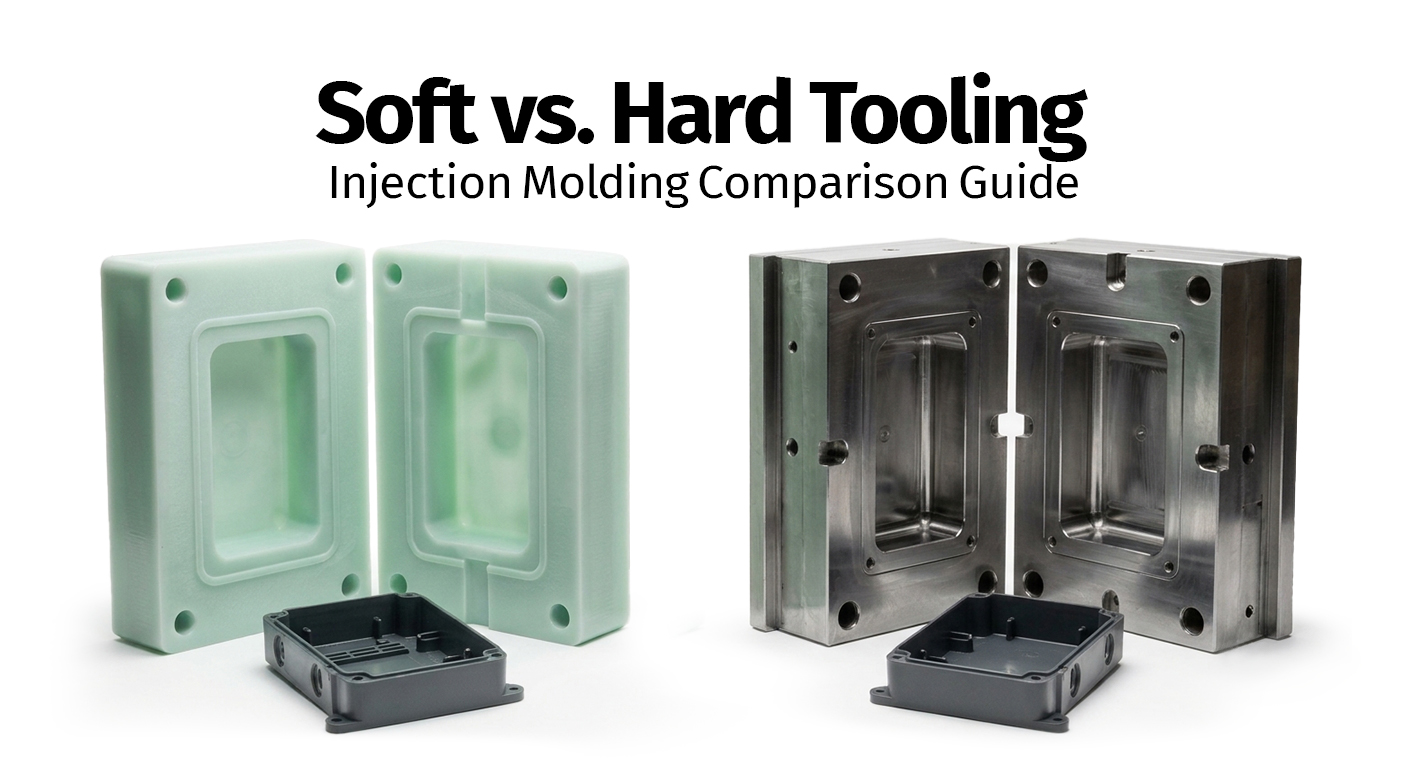
What if making the correct mold choice would determine the success of the next manufacturing project? The selection of tools to be used in injection molding is important, as this decision affects costs, quality of product, speed of production, and the scalability of manufacturing as a whole.
In injection moulding, tooling is broadly classified into two categories: soft tooling and hard tooling. A clear understanding of the benefits of soft tooling helps companies properly plan their manufacturing operations and save unnecessary expenses.
Let’s look at a detailed comparison of the two methods.
Soft Tooling in Injection Molding
Soft tooling creates molds from different soft materials, such as aluminum, epoxy or various alloys of steel. Soft molds are easy to create and perfectly suited for prototype testing and for producing small quantities of goods.
One of the main advantages of soft tooling is its relatively low initial investment. Businesses can use this chance to test their designs and examine how the produced item works as well as what should be improved, without incurring significant expenses for production molds.
Main characteristics of soft tooling:
- Lower starting capital requirements: Molds can generally be manufactured in shorter lead times.
- Faster production preparation: Molds can be produced much faster.
- Perfect for small production runs: Can be used for prototypes, product tests, or low-volume production.
- Shorter lifespan: Softer materials wear out much faster than hardened steel ones.
Hard Tooling in Injection Molding
Hard tooling uses robust materials such as hardened steel and produces molds that are intended for continuous use. These moulds are designed to withstand repeated production cycles and the operating conditions involved in injection moulding.
Hard tooling may be a more costly option compared to other methods and takes time to prepare. However, it offers a longer tool life and can support consistent dimensional accuracy across extended production runs when the mould is properly designed and maintained.
Hard tooling offers better overall benefits for large-scale companies manufacturing thousands of identical products by reducing the cost per component.
Key characteristics of hard tooling include:
- High durability: Designed to withstand a large number of injection moulding cycles.
- Proper output: Guarantees repeatability of the size and quality of the products.
- High initial costs: Requires larger investments in materials, machining, and finishing.
- Longer preparation time: Complex molds need work by engineers to prepare them.
Key Differences: Hard Tooling vs. Soft Tooling
Both methods of tooling are applicable to the process of injection molding. However, the selection of the manufacturing method is determined by the type of production, budget, and intricacy of goods produced.
| Comparison Factor | Soft Tooling | Hard Tooling |
| Mold materials | Aluminium, epoxy, softer steel | Hardened steel |
| Initial investment | Relatively low | Relatively high |
| Production volume | Low to medium | Medium to high |
| Tool life | Comparatively shorter | Significantly longer |
| Lead time | Generally shorter | Generally longer |
| Maintenance | May require earlier replacement | Designed for extended use |
| Best suited for | Prototypes and small batches | Large-scale or mass production |
The choice is not simply about selecting the less expensive mould. Businesses should also consider production volume, expected tool life, component requirements, and long-term manufacturing costs.
Benefits of Injection Molding for Modern Manufacturing
Injection molding is one of the most popular manufacturing methods due to the fact that it is effective, flexible, and provides great quality. It is predicted that the world market of plastic injection molding will reach $235.7 billion by 2029 which will mean an average annual increase rate of 4.1 percent.
Some of the major advantages of injection molding are:
- High production efficiency: Repeated production cycles allow the creation of an impressive number of different components quite effectively.
- Design flexibility: Complicated shapes and intricate details of products can be achieved with the help of proper mold engineering.
- Material flexibility: Different kinds of thermoplastics can be used depending on the strength, flexibility, and application of the product.
- Low costs: The more units are produced, the less spending will be required for making one product.
- Consistent quality: Controlled process parameters and properly maintained moulds help maintain consistent component dimensions and quality across production runs.
These features make injection molding well-suited for the automotive, electrical, consumer electronics, and other manufacturing fields where repeatable component production and material selection are important.
Vacuum Casting Services vs. Injection Molding: Which Is Better?
Vacuum casting and injection molding are two different types of manufacturing processes that meet different production needs.
Vacuum casting uses silicone moulds and typically polyurethane casting resins to produce parts, often for prototyping and low-volume requirements. Injection moulding involves injecting molten thermoplastic into specially made molds under pressure.
| Factor | Vacuum Casting | Injection Molding |
| Mold material | Silicone | Aluminium or steel |
| Production volume | Low-volume batches | Low to high volumes |
| Initial tooling cost | Generally lower | Generally higher |
| Material options | Primarily casting resins | Various thermoplastics |
| Best application | Functional prototypes | Production components |
Vacuum casting is beneficial for companies that need prototypes with good surface quality and efficiency of a product prior to creating injection tools. Injection moulding is generally more suitable when production requires repeatable components in larger quantities.
For instance, a developer may use vacuum casting to check if the casing for the product is well designed and then start the injection molding process. This helps them find problems in the design at the beginning and save on larger manufacturing investment.
How to Choose Between Soft and Hard Tooling?
Choosing the proper method of tooling is not limited to comparing the costs of molds. Businesses should examine their manufacturing requirements thoroughly.
1. Expected Production Volume
Estimate how many components are needed during the product’s lifetime. Soft tooling can be suitable for prototypes and smaller production runs, while hard tooling may be more economical for higher volumes due to its longer service life.
2. Product Complexity
It’s important to keep in mind the complexity of the product when designing the mold, as intricate components with complex geometry, high precision tolerances, or intricate features require careful design.
3. Budget and Production Timelines
If the priority is to evaluate a design with a lower initial tooling investment and shorter lead time, soft tooling may be suitable. Hard tooling should be taken into account when considering long-term production.
4. Future Scalability
Consider future potential. It is possible to avoid future costs related to engineering and replacement by implementing a tooling solution that ensures meeting future production needs.
Conclusion
The decision of choosing soft vs. hard tooling methods can be made according to the amount of required production, financial resources, complexity of the product, and future objectives.
Partnering with an experienced company simplifies decision-making. As an injection molding company in India, Cubein helps companies choose the right injection tooling method. At Cubein, we help businesses at different stages of product development, from idea and prototyping to mass production.
FAQs
1. What is the main difference between soft and hard tooling?
Soft tooling uses soft mold materials suitable for production in smaller quantities, while hard tooling implies the use of stronger materials such as hardened steel to produce various items in larger quantities.
2. Is soft tooling more cost-effective than hard tooling?
Soft tooling generally involves a lower initial investment, making it suitable for prototyping and smaller production batches. Hard tooling may become more economical at higher production volumes because its longer tool life can spread the initial tooling cost across more components.
3. When should companies opt for using hard tools?
Typically, hard tooling is preferable in cases when a consistent quality is required at a large output volume with a long life cycle of a mold tool.
4. Are vacuum casting and injection molding similar?
Vacuum casting is effective for developing prototypes of low volume, while injection molding is more cost-effective in case of creating a larger batch of products.
Other Blog
Top Injection Molding Trends to Watch in 2026 and Beyon...
2026 Injection Molding Trends Manufacturers Must Know
Read More
How Vacuum Casting Services Help Reduce Production Cost...
How Vacuum Casting Services Help Reduce Production Costs and Lead Times
Read More
Best Materials for Fused Deposition Modeling 3D Printin...
Best Materials for Fused Deposition Modeling 3D Printing
Read More
The Role of Industrial Design in Smart Home Product Dev...
The Role of Industrial Design in Smart Home Product Development
Read More
Reverse Engineering vs Redesign: Cost, Time & Use ...
Reverse Engineering vs Redesign: Cost, Time & Use Cases
Read More
How Automation Improves Efficiency in Injection Molding...
How Automation Improves Efficiency in Injection Molding Services
Read More
Revolutionize Your Business with 3D Printing Services i...
Revolutionize Your Business with best 3D Printing Services in India
Read More
Vacuum Casting Services for High-Accuracy End-Use Parts
Vacuum Casting Services for High-Accuracy End-Use Parts
Read More
Fused Deposition Modeling 3D Printing for Industrial Pa...
Fused Deposition Modeling 3D Printing for Industrial Parts
Read More